Why Musicians Keep Coming Back to the Mountains (And Turning Down Bigger Checks to Do It)
There's a booking agent in Nashville who's stopped being surprised when her clients turn down stadium support slots for weekend gigs at high-altitude venues in Colorado or Montana. It used to feel like a red flag — a sign that an artist was retreating from ambition. Now she calls it a strategy.
"The first time one of my guys did it, I thought he was losing his mind," she said, laughing. "By the third time, I started asking different questions. Like, what are these places offering that I'm not seeing on a spreadsheet?"
The answer, it turns out, is a lot.
The Spreadsheet Doesn't Capture Everything
On paper, the math for mountain venues has never made sense for established artists. Capacity is smaller. Guarantees are lower. The logistics — altitude, weather, limited backstage infrastructure — are genuinely harder to manage than a well-oiled arena operation.
And yet, artist return rates at mountain festivals and venues across the American West are quietly becoming one of the most talked-about metrics in the live events industry. Some regional mountain festivals report that upward of 60 percent of their performing artists have played the event before — not because they had to, but because they asked to come back.
That's almost unheard of in an industry where novelty drives bookings and agents are always chasing the next new room.
So what's actually going on?
Creative Freedom as a Booking Tool
Talk to enough touring musicians and a pattern emerges pretty fast. Mountain venues, particularly the independent ones, tend to give artists something the arena circuit systematically removes: control.
Control over set length. Control over set order. Control over how the stage is lit, how the crowd is managed, whether the artist can wander into the audience during an acoustic number without a security team losing their minds.
One folk-rock guitarist who tours roughly 200 days a year described a mountain gig in Wyoming where the production team handed him a laminated card listing what they needed from him — and told him the rest was his call. "In twenty years of touring, that has never happened," he said. "Usually it's a forty-page rider and a production manager who's mad at you before soundcheck."
That kind of latitude isn't just a perk. For a lot of artists, it's genuinely transformative. Sets become experiments. Songs get rearranged on the fly. Collaborations happen because two artists are staying at the same lodge and one of them has a guitar.
The mountain stage, in other words, becomes a creative laboratory in a way that a 20,000-seat amphitheater simply cannot.
The Acoustic Argument
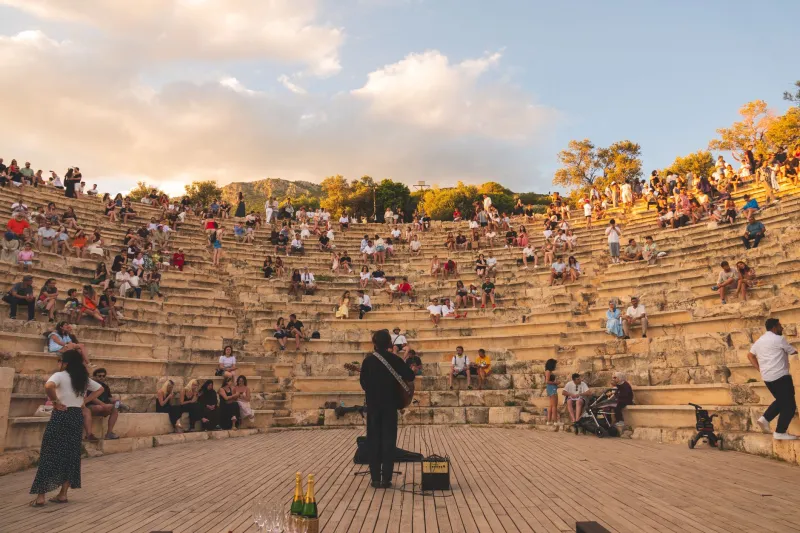
It would be easy to dismiss the sound quality conversation as romanticized musician-talk, but the physics are real. Open-air mountain venues, particularly those built into natural bowls or backed by rock faces, produce acoustic environments that are genuinely difficult to replicate at sea level.
Lower air density, reduced background noise pollution, and the natural amphitheater effect of mountain topography all contribute to a listening experience that audiences describe with words like "intimate" and "raw" — even at outdoor venues with several thousand attendees.
For artists who care deeply about how their music actually lands in a room, this matters more than most people outside the industry realize. Several touring musicians have described mountain gigs as the closest thing to a perfect monitor mix they've ever experienced — where the sound coming off the stage feels honest rather than engineered.
"You hear yourself differently up there," said one singer-songwriter who has played festivals across the Rockies for the past decade. "It sounds like the record you meant to make, not the one that got compressed to death."
The Community Effect
Here's the part that really separates mountain venues from their urban counterparts: the audience.
People who travel to mountain festivals — and travel is almost always involved, given the geography — are not casual concertgoers. They've planned, budgeted, packed, and often driven several hours to be there. That level of intentionality creates a crowd energy that artists consistently describe as unlike anything they experience at a general-admission city show.
But more than the energy, it's the consistency of that audience over time. Mountain festival regulars tend to be deeply loyal, both to the event and to the artists they discover there. They follow up. They buy records. They show up to the next tour date in Denver or Salt Lake City because they saw someone play a barn stage in the mountains three summers ago and never forgot it.
For emerging and mid-level artists especially, that kind of audience-building is priceless. It's the difference between a one-night transaction and the beginning of a career-long relationship.
"My most loyal fans found me at altitude," one Americana artist told us. "I can track it. I know exactly which festival, which set, which song. Those people are still with me eight years later."
What This Means for Live Music Geography
The broader implication of artist loyalty to mountain stages is starting to reshape how people in the industry think about touring geography.
For decades, the conventional wisdom was that a successful touring route ran through major metros — New York, LA, Chicago, Nashville, Austin. Mountain markets were afterthoughts, flyover stops between real dates.
That calculus is shifting. Booking agents are increasingly treating mountain venues not as charity gigs or brand-building exercises, but as anchor dates — the shows around which the rest of a regional tour gets organized. The logic is simple: if the mountain date delivers a better artist experience and a more engaged audience, why wouldn't you build around it?
Some festival directors in Colorado and Utah have started quietly pitching themselves to artist management teams not as a single booking opportunity, but as a long-term creative home. The language they use sounds less like event promotion and more like artist residency programs.
Whether that pitch lands depends on the artist. But the fact that it's being made at all says something important about where the leverage in live music is starting to move.
The View From the Stage
None of this means that arenas are going anywhere. The economics of the major touring circuit aren't going to be disrupted by a few thousand people on a hillside in the Rockies.
But the mountain stage is carving out a distinct and increasingly valuable lane — one defined not by scale, but by depth. Deeper artist relationships. Deeper audience loyalty. A deeper connection between the music and the place where it's being played.
For the musicians who've experienced it, the pull is hard to explain to someone who hasn't stood on a stage with a mountain range behind them and a crowd that drove four hours to be there.
"You play a show like that and then you go back to a casino ballroom in a city somewhere and the lights are the same and the sound is the same and nothing about it is specific to anywhere," one veteran touring guitarist said. "The mountain shows are somewhere. Everything else starts to feel like nowhere."
That somewhere is starting to look like a very smart place to build a career.