Thin Air, Big Sound: The Science Behind Why Mountain Stages Hit Different
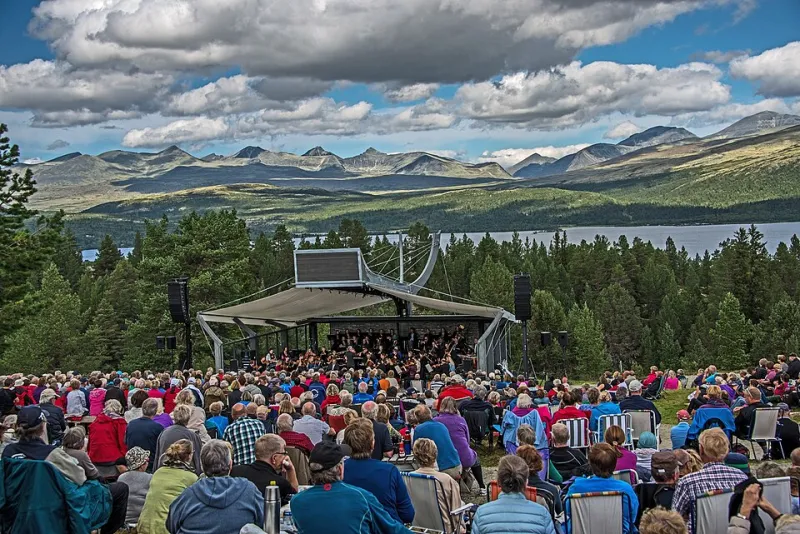
Photo: Arne Hernæs, CC BY 2.5, via Wikimedia Commons
You've probably had that moment. You're standing at some open-air venue carved into a mountainside, the band kicks in, and the sound wraps around you in a way that feels almost unfair. Like the mountain itself is in on the performance. You chalk it up to the vibe, the altitude buzz, maybe the craft beer. But acoustical engineers will tell you something different: the mountain is absolutely in on it, and it's doing a lot of the heavy lifting.
High-altitude concert experiences are having a serious moment in the American live music scene, from Colorado's Red Rocks Amphitheatre — sitting at just over 6,400 feet — to smaller boutique festival stages tucked into the Rockies, the Sierra Nevada, and the Appalachian highlands. And the reason these venues keep showing up on musicians' wish lists isn't just aesthetic. There's measurable science behind why a performance at elevation sounds fundamentally different from one at sea level.
What Altitude Actually Does to Sound
Here's the basic physics. Sound travels as a pressure wave through air, and the properties of that air — its density, temperature, and humidity — directly affect how those waves behave. At higher elevations, air is thinner. There are fewer air molecules per cubic foot, which means sound waves encounter less resistance as they move. The result? Sound travels faster and, in many open-air contexts, with a kind of clarity that can feel almost unnatural to ears trained on sea-level venues.
"The decreased air density at altitude reduces what we call atmospheric absorption," explains one acoustical consultant who has worked on outdoor venue design across the Mountain West. "Particularly in the higher frequency ranges — the upper harmonics, the shimmer on cymbals, the air around a vocalist's voice — you're losing less of that energy to the atmosphere before it reaches the listener. Things that might sound slightly muddled at sea level arrive intact."
It's worth noting that this effect is more pronounced in open-air settings than in enclosed halls, but even indoor mountain venues benefit from the drier, thinner air that characterizes high-altitude climates. Lower humidity means less moisture in the air to scatter and absorb sound waves, which contributes to that crispness performers often describe when they play above a certain elevation.
The Terrain Factor: Nature's Best Sound Design
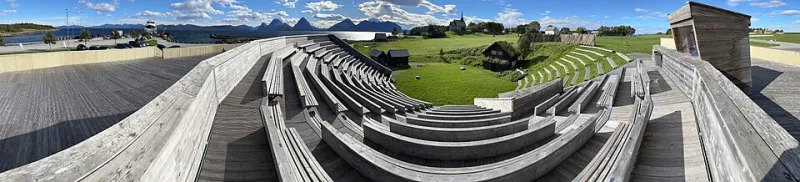
Beyond the air itself, the physical landscape of mountain venues creates acoustic conditions that no amount of studio engineering can fully replicate. Bowl-shaped amphitheaters, like the natural rock formations at Red Rocks, act as giant parabolic reflectors, bouncing sound back toward the audience from multiple angles simultaneously. The effect is an immersive, enveloping quality that audio engineers spend entire careers and massive budgets trying to approximate indoors.
But it's not just the dramatic, purpose-built venues that benefit. Even a small festival stage set against a cliff face or nestled in a valley between ridgelines can generate natural reflections that add depth and dimension to a live performance. The irregularity of rock surfaces — compared to the flat walls of a conventional indoor venue — scatters sound in ways that reduce harsh echoes while maintaining warmth and presence.
"Nature is a genuinely remarkable acoustic architect," says one touring sound engineer who has mixed front-of-house for major acts at altitude venues across the US and Europe. "You show up to some of these mountain stages and the terrain has already done half your job for you. You're working with the environment rather than fighting it."
Why Musicians Keep Coming Back to the Mountain
Talk to enough touring musicians and a pattern emerges. Certain venues become almost mythological in the way artists describe performing there, and a disproportionate number of them are at elevation. It's partly the visuals, sure — nobody's complaining about a sunset over the Rockies as a backdrop. But performers consistently describe something in the sound itself that pulls them back.
Vocalists in particular often note that high-altitude stages feel more forgiving in unexpected ways. The thinner air means less effort is required to project, and the natural acoustic environment tends to reward subtlety in a way that heavily amplified sea-level venues sometimes punish. "You can whisper and the mountain catches it," one folk-rock artist described after a set at a Colorado festival. "It makes you want to play differently. More honestly, somehow."
The psychological dimension is real too. Performing at elevation, surrounded by landscape that dwarfs the stage, tends to shift something in the performer-audience dynamic. The shared experience of altitude — the slight breathlessness, the heightened sensory awareness, the sense of being somewhere genuinely removed from ordinary life — creates an intimacy that even the best urban venues struggle to manufacture.
American Venues Leaning Into the Science
The live music industry in the US is increasingly aware that altitude isn't just a backdrop — it's an asset. Venue designers and festival organizers in mountain states are starting to make deliberate choices based on acoustic geography rather than just logistical convenience. Site selection now sometimes involves acoustic mapping of natural terrain, identifying locations where existing topography will complement sound reinforcement systems rather than complicate them.
Some venues are going further, working with acoustical engineers to design stage orientations and audience configurations that maximize the reflective properties of surrounding rock faces and ridgelines. It's a discipline that sits somewhere between traditional concert hall acoustics and landscape architecture, and it's producing results that are genuinely hard to replicate anywhere else.
For American audiences increasingly hungry for live experiences that feel meaningful and singular — not just another arena show with better merch — the mountain stage offers something that can't be streamed, sampled, or scaled. The physics are the point. The altitude is the feature.
Next time you find yourself at a high-elevation show, breathless from the climb and the opening chord, remember: the mountain isn't just the scenery. It's the instrument.