Why Your Ears Are Telling You the Truth: The Real Science of Mountain Sound
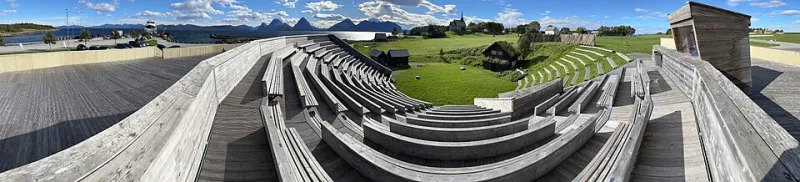
Photo: Wolfmann, CC BY-SA 4.0, via Wikimedia Commons
You've probably felt it before. You're standing at some outdoor venue tucked into a Colorado valley or perched on a Montana hillside, and the music sounds — well, cleaner. Sharper. Like someone turned up the clarity dial without touching the volume. You might have chalked it up to fresh air and good vibes, but it turns out there's actual physics at play. Mountain venues don't just look dramatic. They sound different, and the reasons why are genuinely wild.
Thin Air, Thick Sound — Wait, What?
Here's the counterintuitive part: less air doesn't mean less sound. At high elevation, the atmosphere is thinner, which means there are fewer air molecules to absorb and scatter sound waves as they travel. The result? Sound travels with less resistance, arriving at your ears with more of its original energy intact.
"At sea level, you lose a measurable amount of high-frequency energy over distance," explains Marcus Trent, a live audio engineer who has worked festivals from Red Rocks to the Telluride Bluegrass Festival. "Get up to 6,000 or 7,000 feet and that loss is noticeably reduced. The highs stay crisp. The mids don't get muddy. You're essentially getting a cleaner signal from the stage."
The technical term acousticians use is atmospheric absorption — the way humidity, temperature, and air density eat into sound waves over distance. Lower humidity levels common at altitude (especially in the American West) compound this effect. Dry air is simply better at transmitting sound cleanly than the thick, humid air you'd find at a coastal amphitheater in August.
Terrain as a Natural Speaker Cabinet
Then there's the geography itself. Alpine venues — whether they're deliberately designed or naturally occurring bowls carved by glaciers — act like giant acoustic shells. Rock faces, ridge lines, and forested slopes reflect and focus sound in ways that no flat-field festival can replicate.
Dr. Alicia Romero, an architectural acoustician based in Denver who has consulted on several mountain venue projects, puts it this way: "A natural rock amphitheater is doing something that took human engineers decades to figure out how to build artificially. The concave geometry gathers sound and directs it toward the audience. You get this sense of envelopment — like the music is surrounding you rather than just hitting you from one direction."
This is part of what makes Red Rocks Amphitheatre in Morrison, Colorado so legendary. The two massive sandstone formations flanking the stage aren't just photogenic — they're functioning acoustic reflectors, bouncing sound back into the seating area with a warmth and dimensionality that's nearly impossible to recreate elsewhere. Sound engineers who work there regularly describe it as one of the most forgiving outdoor rooms they've ever mixed in.
Temperature, Wind, and the Wild Cards
Of course, mountain acoustics aren't a guaranteed win. Elevation introduces variables that can work against you just as easily as for you. Temperature gradients — the way air cools rapidly as you gain altitude — can cause sound to bend upward and away from audiences, a phenomenon called refraction. Evening shows, when temperatures drop quickly after sunset, can shift the sonic character of a performance noticeably between the opening act and the headliner.
Wind is the other big wildcard. Mountain terrain channels airflow in unpredictable ways, and even a moderate breeze can scatter high frequencies and create dead spots in a venue. Experienced engineers account for this by positioning speakers more aggressively and relying less on natural reflection when wind conditions are sketchy.
"Every mountain show is a little bit of a puzzle," says Trent. "You're working with the landscape instead of against it, which is actually a lot more interesting than mixing in a controlled indoor space. But you have to stay on your toes."
What This Means for You as a Concertgoer
Knowing the science is cool, but here's how to actually use it the next time you're at a high-altitude show.
Arrive early and walk the venue. Sound behaves differently in different parts of an outdoor mountain venue. Spend ten minutes during soundcheck exploring. You'll find sweet spots — usually somewhere in the middle third of the seating area where direct sound from the stage and natural reflections from surrounding terrain converge.
Go for center, not front. Unlike indoor clubs where being right against the stage is the prize, mountain venues often reward positioning over proximity. Dead center, slightly elevated from the stage, frequently offers the best stereo imaging and the most balanced mix.
Pay attention to the set time. Early evening sets, before temperatures drop significantly, tend to offer the most consistent acoustics. Late-night performances can be magical for other reasons, but the sonic character will shift.
Protect your hearing differently. Thinner air means sound travels more efficiently, which can make high-volume performances feel slightly less punishing — but don't let that fool you. Your ears are still taking in the same decibels. High-fidelity earplugs (the kind that reduce volume without killing clarity) are especially worth it at mountain festivals where you might be listening for six or eight hours across multiple days.
The Alpine Advantage Is Real
European mountain festival culture has understood this intuitively for generations. Festivals in the Swiss Alps, Austrian valleys, and the Dolomites have been leveraging natural terrain acoustics for decades, building stages that work with geography rather than imposing a one-size-fits-all setup onto the landscape.
American venues are catching up fast. From the purpose-built stages at Telluride's Town Park to the informal meadow shows that pop up across the mountain West every summer, there's a growing recognition that altitude isn't just a backdrop — it's a genuine part of the sonic experience.
Next time someone tells you the show just sounded better up in the mountains, you can nod knowingly. It wasn't the altitude getting to your head. It was the altitude doing exactly what physics says it should.