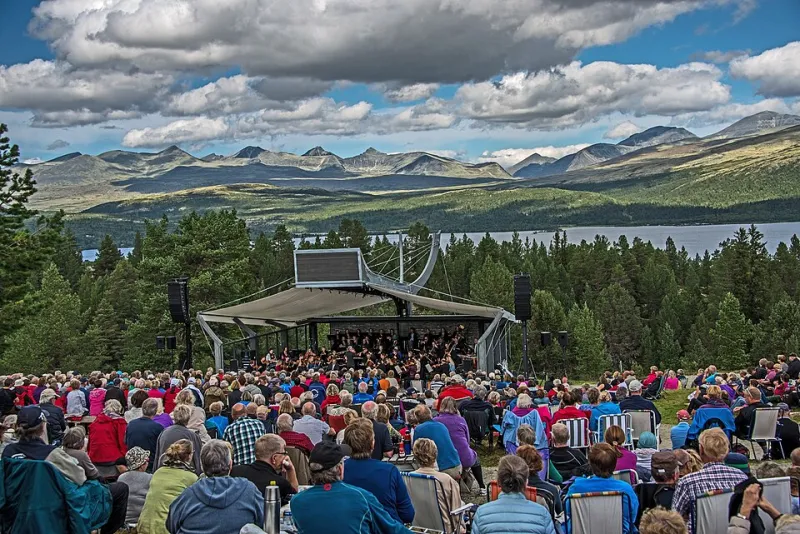
Why the Air Up There Sounds Better: The Hidden Physics of High-Altitude Concerts
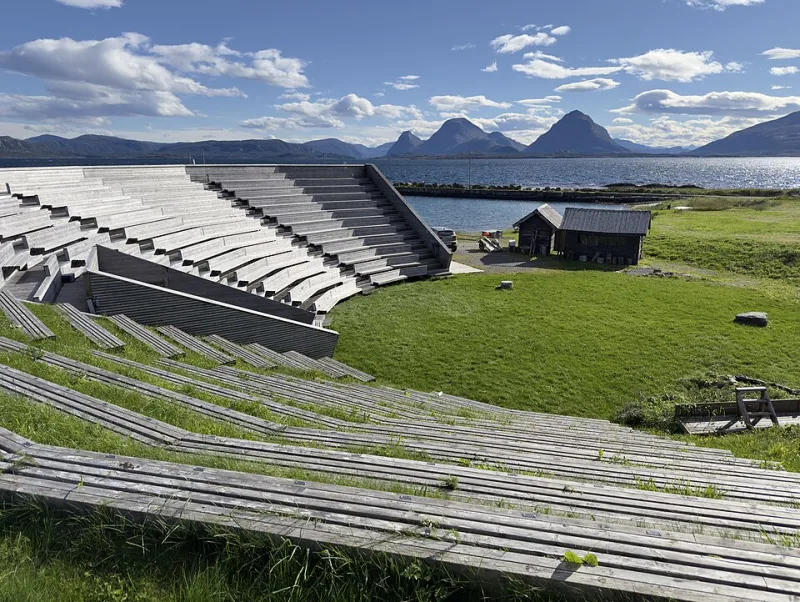
Photo: Wolfmann, CC BY-SA 4.0, via Wikimedia Commons
Anyone who's caught a show at Red Rocks Amphitheatre outside Denver, or stumbled into a festival set somewhere in the Rockies, knows the feeling. Something is different up there. The music hits harder. The crowd feels more electric. You walk out of the venue convinced you just witnessed the best performance of your life — and you can't entirely explain why.
Turns out, you're not imagining it. And the explanation involves physics, biology, and a little bit of what sound engineers quietly refer to as "the altitude advantage."
Sound Waves Don't Like Thick Air
Here's the basic physics: sound travels as a pressure wave through air. The denser the air, the more the wave has to push through, which affects how frequencies behave over distance. At sea level, lower frequencies tend to get muddy at large venues because the air is doing a lot of work to carry them. At elevation — say, 6,000 feet or higher — the air is thinner, and that changes the acoustic equation.
Lower air density means reduced atmospheric absorption, particularly in the mid-to-high frequency range. In plain terms, the highs stay crisp over longer distances. The spatial separation between instruments becomes more defined. It's not that the sound is louder — it's that it's cleaner.
For outdoor amphitheaters built into natural rock formations (Red Rocks being the most famous American example, sitting at about 6,450 feet), this matters enormously. The natural bowl shape already does a lot of acoustic work, but the elevation amplifies the effect. Sound engineers who've worked both coastal and mountain venues consistently describe mountain gigs as requiring less correction in the mix.
"At sea level in a big outdoor space, you're fighting the air as much as you're shaping the sound," says one veteran live sound engineer who's worked tours across North America and Europe. "In the mountains, the room — even if it's the sky — is cooperating with you."
What Your Body Is Doing During a Mountain Show
The physics is only half the story. Your body at elevation is a genuinely different instrument than your body at sea level, and that changes how you experience music from the inside out.
At altitudes above 5,000 feet, your blood oxygen saturation starts to drop modestly — not dangerously, but enough to trigger a mild physiological stress response. Your heart rate ticks up. Your body releases slightly more adrenaline and norepinephrine to compensate. Your senses sharpen. Your brain, in a very real sense, becomes more alert.
Now combine that with the sensory input of a live concert — the volume, the light show, the crowd energy — and you've got a feedback loop. The adrenaline your body is already producing to handle the altitude gets channeled directly into the emotional experience of the music. The euphoria feels amplified because, biochemically, it is.
This also helps explain why ear pressure during mountain concerts can feel more intense. Your Eustachian tubes are already working harder to equalize pressure at elevation. Add a loud bass drop and a packed crowd, and the sensation becomes more physical, more visceral. It's not necessarily comfortable, but it is memorable.
Why Some Artists Actually Seek Out Elevation
You might assume performers would prefer lower altitudes — easier breathing, better vocal stamina, less physical strain. And for some, that's absolutely true. High-elevation shows are notoriously demanding on singers, whose vocal cords dry out faster in thin, dry mountain air.
But a notable subset of artists actively seek out mountain venues, and the reasons are partly about the crowd and partly about their own experience on stage.
"There's a feedback loop with the audience at altitude that you don't get at a flat, urban venue," one touring musician described after a run of Rocky Mountain dates. "Everyone in that crowd is already slightly elevated — in every sense of the word. They're responding to the music differently. And that comes back at you."
The Alpine-influenced festival circuit in Europe has understood this for decades. Events in the Swiss Alps, the Austrian Tyrol, and the Bavarian highlands have long leaned into the elevation as part of the experience — not just scenery, but atmosphere in the most literal sense. American promoters have been catching up, particularly in Colorado, Utah, and parts of the Pacific Northwest.
The Venues That Are Engineering the Effect
Some mountain venues aren't just passively benefiting from their altitude — they're actively designing for it.
Red Rocks is the obvious benchmark, but newer developments in the mountain festival space have taken the concept further. Outdoor stages built into natural terrain with deliberate sightline angles that also function as acoustic reflectors. Lodge-style venues where the low wooden ceilings and stone walls create intimate reverb profiles that complement the thin-air exterior. Sound systems calibrated specifically for the air density at a given elevation, rather than using standard sea-level settings.
Sound engineers working on permanent mountain installations now routinely factor elevation into their speaker placement calculations. The math for throwing sound across a 5,000-seat outdoor venue at 8,000 feet is genuinely different than it is at 500 feet, and the teams that get it right create experiences that feel almost unfairly good.
There's also a growing conversation among venue designers about the psychological component — the way mountain settings prime audiences to feel awe before a single note is played. Walk into a natural amphitheater with pine-covered ridges on three sides and a sky that actually feels closer, and your brain is already in a receptive state. The music lands in a different context.
The Takeaway for Concert Goers
If you've never made the trip to a mountain venue for a show you care about, the case is stronger than you might think. The experience isn't just about the views (though yes, the views are absurd). It's about the fact that your ears, your body, and the physics of the space are all working together in ways that flat-land venues simply can't replicate.
Drink water. Give yourself a day to acclimate if you're coming from sea level. And maybe skip the third beer before the headliner — your body's already doing enough interesting things without the extra help.
The mountains have been hosting music for centuries, from Alpine folk traditions to the grand outdoor festivals of the European highlands. American concert culture is finally catching on to something that's been true all along: elevation isn't just a location. It's an ingredient.