Storm Stories: The Mountain Festival Moments That Weather Made Unforgettable
Somewhere in Colorado, a woman named Dana still has a video on her phone from three summers ago. It's shaky, dimly lit, and the audio is a mess of wind and crowd noise. You can barely make out the stage. But she's watched it probably two hundred times.
What you can see, if you look closely, is snow. In July. At a music festival. And what you can hear, underneath all the chaos, is an artist who kept playing anyway — and a crowd that responded like they'd just witnessed a miracle.
"I've been to maybe forty concerts in my life," Dana says. "I remember maybe five of them. That one I'll remember forever."
This is the paradox at the heart of mountain festival culture. The thing that should be the worst-case scenario — weather turning on you, conditions going sideways, plans falling apart — has a strange tendency to become the best-case story. Not always. Not automatically. But often enough that seasoned alpine organizers have stopped dreading the forecast and started learning how to work with it.
The Storm That Became the Show
Festival organizers who work in mountain environments develop a particular relationship with weather forecasting that's somewhere between science and superstition. They check apps obsessively. They call local meteorologists. They read cloud formations like tea leaves. And then, frequently, the weather does whatever it was going to do regardless.
"You can prepare for almost anything," says one longtime festival director who has run events in Wyoming for over a decade. "But you can't control it. At some point you just have to trust your protocols and trust your team, and accept that the mountain is going to have opinions."
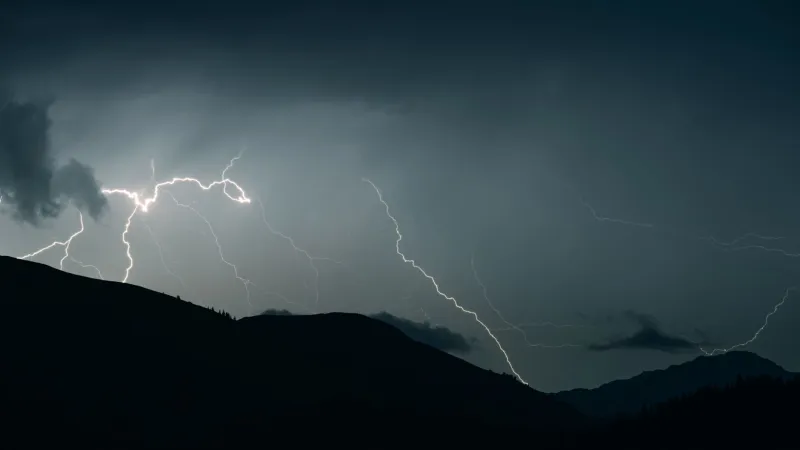
His most-told story involves a lightning event that shut down a main stage mid-headliner. Standard protocol: clear the field, move people to shelter structures, wait out the cell. What happened next was not in any protocol. A guitarist from the opening act found an acoustic guitar and started playing from under a food vendor's canopy. A dozen people gathered. Then a hundred. By the time the lightning cleared forty minutes later, there was an impromptu acoustic session happening in the rain that people were filming from every angle.
The headliner came back and played an extended set. But in post-event surveys, the lightning set was what people mentioned most.
Fog, Snow, and the Theatre of Uncertainty
Not every weather story involves danger. Some of the most memorable alpine festival moments come from conditions that are merely dramatic rather than threatening.
Fog is a particular favorite. When a low cloud rolls in over an outdoor mountain stage at the right moment — mid-song, mid-set, at that exact point where the music is building toward something — the effect is genuinely cinematic. Artists have been known to stop mid-sentence when it happens, just to let the audience absorb it. No light designer on earth could replicate it.
Snow in summer is rarer but perhaps even more striking. Several festivals in higher elevations across the Rockies and Sierra Nevada have experienced surprise snowfall during summer programming, and without exception, the accounts from attendees describe something close to euphoria. There's a particular cognitive dissonance to standing in a crowd, hearing live music, and watching snow fall in August — a combination so improbable that it feels almost fictional. The brain doesn't quite know how to categorize it, and that confusion translates into heightened memory formation.
"People keep saying it felt like a movie," recalls one artist who experienced an unexpected snowfall mid-set at a Colorado festival. "I've played in a lot of wild conditions. That one was different. The crowd just went completely quiet for a second, and then erupted. I've never felt anything like it."
What Organizers Actually Do When It Goes Wrong
For all the romance of the weather story in retrospect, the reality of managing an unexpected weather event at a remote mountain venue is genuinely stressful. And the difference between a legendary moment and a logistical nightmare often comes down to how prepared the team was before anything happened.
Best-in-class mountain festival organizers invest heavily in what they call "weather intelligence" — not just forecasting, but real-time monitoring, established relationships with local emergency services, and clear internal protocols that every team member knows cold. When a storm cell appears on radar, there's no debate about who makes the call to pause programming. That decision tree is already mapped.
Shelter infrastructure is another critical factor. Remote venues that have invested in substantial covered areas — not just a tent or two, but genuine weather shelter for a significant portion of their capacity — have far more flexibility when conditions shift. They can pause, protect their audience, and resume. Venues without that infrastructure face a much starker choice between continuing in dangerous conditions or ending the event entirely.
The best outcomes happen when organizers communicate fast and honestly. Audiences at mountain festivals tend to be resilient and adaptable — they chose an outdoor mountain experience, after all, which suggests a certain tolerance for unpredictability. What erodes trust is vagueness or delay. A clear, quick announcement that explains what's happening and what the plan is tends to land well, even when the news isn't great.
The Artist Factor
One variable that separates memorable weather moments from merely miserable ones is how the performing artist responds. And this is where mountain venues have a quiet advantage over their urban counterparts: the artists who choose to play these stages tend to self-select toward adaptability.
Musicians who seek out mountain venues are generally not the kind of performers who require perfect conditions to deliver. They're drawn to the unpredictability, the intimacy, the sense that anything could happen. When something does happen, they're often better equipped — emotionally and practically — to roll with it.
The stories that circulate in mountain festival circles are almost always stories of artists who leaned in: who made jokes about the weather, who kept playing through light rain when they could have stopped, who came back for an extra set after a delay and played like they had something to prove.
"The mountain tests you," says one festival director with a certain quiet pride. "And the artists who pass that test — the crowd never forgets them."
Why the Hard Moments Stick
There's actual psychology behind why adversity sharpens memory. Events that carry emotional intensity — surprise, mild fear, collective uncertainty — are encoded more deeply than comfortable, predictable ones. The technical term is "emotional memory consolidation." The festival version is just: the night the storm came in is the night nobody can stop talking about.
Mountain festivals, almost structurally, create the conditions for these moments. The environment is inherently dynamic. The setting is inherently dramatic. And when something unexpected happens within that context, the amplifying effect is extraordinary.
Dana, back in Colorado, still talks about her July snowstorm show to anyone who'll listen. She's brought five friends to that same festival in the years since. None of them have seen snow. But they keep coming back, just in case.
That's the mountain doing its job.